Entradas

This-That/ Indefinite articles

Imagen
The words ‘this’ and ‘that’ are demonstrative pronoun which is used for indicating something.  We use the word ‘ this ‘ to point out a person or object which is close to you. On the other hand, ‘ that ‘ is used to point out a person or an object which is farther from you. BASIS FOR COMPARISON THIS THAT Meaning This is a pronoun and determiner used to identify someone or something near to the speaker. That is a pronoun and determiner used to identify someone or something at a distance to the speaker. Refers to Something which is just mentioned. Something which is previously mentioned. Plural form These Those Conjunction No Yes Examples Did you know this person? That's not my cup of tea. The water of this river is clean and pure. Bring me that book. This is a very simple exercise. Who is that boy? You can create questions :                                  ...

Likes and dislikes

Imagen
Things to remember about likes and dislikes: 1.  When these expressions are followed by a verb, the latter is put in the -ing form. Examples: I like listening to music. 2.  Note that”  very much”  & ”  a lot ” always come after the things you like. Examples:   I like basketball  very much/a lot . NOT”  I like very  much/a lot  basketball . Phrases to know:  I’m crazy for … I am crazy for sports My favorite … My favorite movie is Inception I like I like playing soccer with my brother I love I love doing yoga I hate I hate eating vegetables I really hate I really hate doing exercises at school I really adore I really adore happy endings I detest I detest having to come here every summer [noun] is OK A Pepsi is OK I really like I really love going to the beach with my children I really don’t like I really don’t like going to the movies I don’t like I don’t like heavy metal   Likes and Dislikes practice Look at the actions belo...

Telling time

Imagen
  There are two common ways of telling the time. 1) Say the hour first and then the minutes. (Hour + Minutes) 6:25 - It's six twenty-five 8:05 - It's eight O-five (the O is said like the letter O) 9:11 - It's nine eleven 2:34 - It's two thirty-four 2) Say the minutes first and then the hour.  (Minutes + PAST / TO + Hour) For minutes 1-30 we use  PAST  after the minutes. For minutes 31-59 we use  TO  after the minutes. 2:35 - It's twenty-five  to  three 11:20 - It's twenty  past  eleven 4:18 - It's eighteen  past  four 8:51 - It's nine  to  nine 2:59 - It's one  to  three When it is  15 minutes past  the hour we normally say: ( a) quarter past 7:15 - It's (a) quarter past seven When it is  15 minutes before  the hour we normally say:  a quarter to 12:45 - It's (a) quarter to one When it is  30 minutes past  the hour we normally say:  half past 3:30 - It's half past thre...

Simple Present: Verb be short questions and answers.

Imagen
  The basics - structure: The verb  to be  and the subject are reversed in questions (inversion): Affirmative: I You He She It We They am are is is is are are English.   Questions: Am Are Is Is Is Are Are I you he she it we they English? I am  tired. Are you  tired? She is  English. Is she  English? He is  from Barcelona. Is he  from Barcelona? We are  at university. Are we  at university? They are  cold. Are they  cold? John is  hungry. Is John  hungry? John and Mary are  at home. Are John and Mary  at home?   The short answer with the verb  to be . If we answer  yes  or  no  to a question in English, we usually repeat the verb  to be  in the answer. In the negative form, there is often contraction between the verb  to be  or between the subject and the word  not : Are you tired? Yes, I am. No, I am not / No, I'm not. Is she English? Yes,...

Simple Present: Be Affirmative and contractions

Imagen
Verb BE BE is the most important verb in the English language. It is used as a main verb and as an  auxiliary verb , and it is also used in the passive voice. BE is the only English verb that has three conjugations in the  simple present  ( am  |  are  |  is ). All other verbs have just two conjugations. BE is also the only verb that has two conjugations in the  simple past  ( was  |  were ). All other verbs have only one past tense conjugation. Here are the conjugations for BE in the simple present.   singular   plural 1st person I am we are 2nd person you are you are 3rd person he, she, it is they are The verb BE, when followed by an  adjective , is used to describe a person, place, or thing. person   place   thing I am tired. Costa Rica is warm. The building is tall. She is kind. The rooms are large. My ideas are bad. We were late. Paris was beautiful. The tea was cold. The verb BE can be followed by a ...

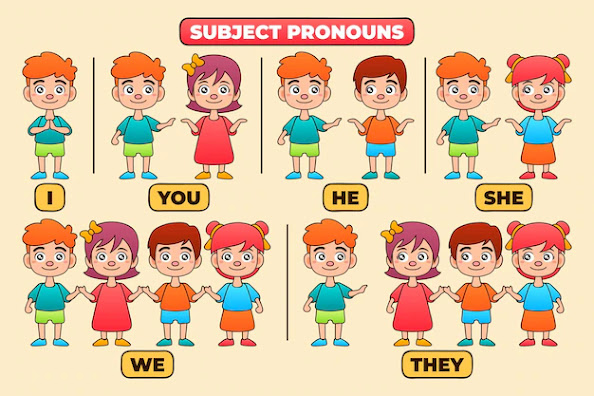
Subject pronouns

Imagen
  Subject pronouns https://youtu.be/Dr8GIp94GgA A subject pronoun is exactly what it sounds like: a  pronoun  that takes the place of a  noun  as the subject of a sentence.

Introducing yourself

Imagen
  https://youtu.be/YVBcFJ_TyLc